Nobody Yells at the Hammer
When you hit your finger with a hammer, you are mad at yourself. When Claude hands back something off, you are mad at Claude. What changed in between? Spoiler: the hammer never told you "You're absolutely right!".
English translation of an article originally written in Spanish. Leer el original en español.
In this article
The finger, the hammer and the idiot
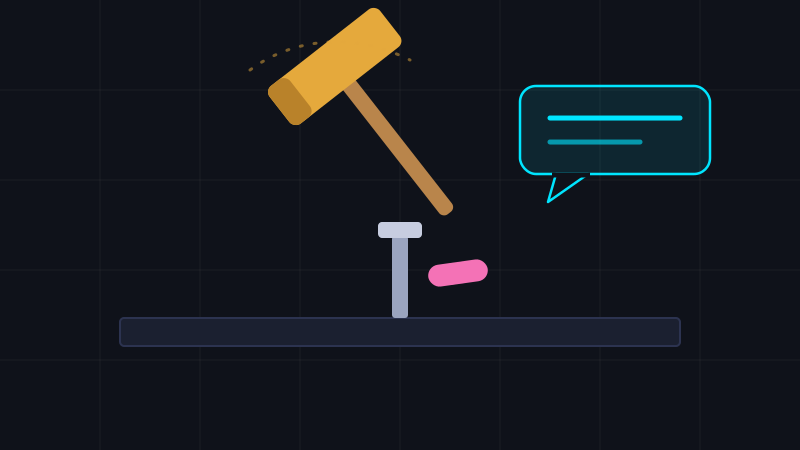
Saturday afternoon. A picture, a nail, a hammer. First swing: perfect. Second swing: the finger.
What follows is a vocabulary I will not reproduce on a site where I want to be taken seriously. But notice something: at no point do you yell at the hammer "why are you doing this to me?". You do not throw it away, you do not leave it a one-star review ("hits fingers, would not recommend"), and you do not explain, slowly and in capital letters, where the nail was.
You know perfectly well who is responsible. The idiot is you.
Now, another scene. You ask Claude "make me a nice landing page for my business". It returns something tidy, correct and utterly generic. And out it comes: "NO, not like that. I said NICE". In capital letters. To a language model.
I have done it. So have you. Some people apologize to AI and some insult it, and both groups share the same secret belief: that someone on the other side takes it personally.
Why we forgive the hammer
If AI is a tool, why don't we treat it like the hammer? I have three suspicions.
1. The hammer is silent. It does not greet you, it does not say "Great idea!" or "Got it, here is an improved version". AI speaks in the first person, apologizes and promises. And when something talks like a person, we judge it like a person: if it promises and does not deliver, we experience it as betrayal, not as a usage failure.
This is not new. In the nineties, Byron Reeves and Clifford Nass showed in The Media Equation that people applied social rules (politeness included) to computers that barely displayed text on a screen. If that happened with a nineties PC, imagine what happens with something that writes you paragraphs with perfect spelling.
2. The hammer shows you the mistake on the spot. Pure physics: crooked swing, purple finger, lesson learned. With AI, the mistake is usually far from the symptom. The bad answer you get now comes from a vague request, from context you never gave, or from a contradictory instruction you left twenty messages ago. You do not see your own hand, so you blame the tool.
3. We do not expect telepathy from the hammer. Nobody believes the hammer should guess where the nail is. With AI, though, we expect it to understand what we meant, not what we said. And "nice", in my head, means something very specific that I never wrote down.
The hammer
- It is silent: it promises nothing
- It shows you the mistake on the spot
- Same swing, same result
- Nobody expects it to guess where the nail is
AI
- It speaks in the first person, apologizes and promises
- The mistake shows up far from the symptom
- The same request can give different answers
- We expect it to understand what we meant
The prompt is your hand
Asking for "a nice landing page" is hammering with your eyes closed. Nice for whom? Minimal or loaded? What are you selling, to whom, in what tone? What do you hate? Claude has not seen your brand, does not know your customer and has no idea that purple gradients give you hives.
Compare it with this:
I need a landing page for a yoga studio in Palermo.
Audience: women aged 30 to 50 who want calm classes, not fitness.
Tone: warm, no motivational-mug slogans.
Style: lots of white, serif typography, no purple, no gradients.
Sections: hero with schedule, teachers, prices, location.
Reference for something I like: [link].
It is not magic, and it is not "prompt engineering" with a capital P. It is the same thing you would tell a human designer on day one. The difference is that you would never hand a human designer a single word and expect them to nail it.
And there is another very common hit to the finger: the endless chat. You are at message 47, correcting corrections of corrections, and the context is already a pile of contradicting instructions. It is like hammering a bent nail. Sometimes the healthiest move is to open a new conversation with a good summary of what you want.
Three failed swings. Decide whose finger it is and compare your diagnosis with the article's.
Swing 1. You ask for "a nice landing page" and get something tidy, correct and generic.
It is the usual reaction, and it is the attribution error: the AI answered what you wrote, not what you pictured. "Nice" was a wish, not an instruction.
Exactly. Without audience, tone, style or sections, any answer is a bet. It is hammering with your eyes closed.
Swing 2. Message 47. You have corrected the corrections and the AI contradicts something you agreed on at the start.
That is hammering a bent nail. Each correction adds another instruction that can contradict the earlier ones and pollutes the context further.
That is cleaning the context. The model is not "hurt": the weights do not change because of your conversation, and a new chat starts clean.
Swing 3. It confidently cites a study that does not exist.
Not necessarily this time. Here the hammer has a loose head: it can fail without you doing anything wrong. Asking for sources helps, but verifying is still on you.
Exactly. This is where the metaphor breaks: AI is not predictable. A good craftsperson checks before swinging and verifies what is critical.
But careful: the hammer does not hallucinate
I have to be honest here, because the metaphor has a limit and I would rather point it out myself before someone does in the comments.
The hammer is predictable. Same swing, same result. AI is not: the same request can give you two different answers. And sometimes it fails without you doing anything wrong. It invents a function that does not exist, cites a phantom source or confidently states something false. That is not your finger: it is a hammer with a loose head.
So yes, some frustrations are legitimate. But even then, a good craftsperson's answer is not to yell at the tool. It is to know it: you know the head sometimes comes loose, so you check before you swing. You ask it to verify, you give it access to the documentation or to web search, you ask for sources and you check what is critical. And you do not use it for what it is not made for, because nobody sues the hammer for not driving screws.
Maybe the most accurate metaphor is not the hammer but a very fast, very well-read apprentice who does not know your workshop. Give it context and it flies. Speak to it in hieroglyphs and it returns hieroglyphs in very nice prose.
Before yelling at the screen
A short checklist I built for myself, which has saved me several tantrums:
- Did I say what I wanted, or what I imagined?
- Did it have the context I have in my head?
- Did I ask it to verify what it claims, or did I take it for granted?
- Am I at message 47, correcting on top of corrections?
- Is this a task for this tool, or am I asking it to drive screws?
If all five answers leave me standing, only then do I allow myself to get angry. Spoiler: it almost never happens.
The tool that answers back
There is a detail that seems to break the metaphor. The hammer cannot decide it no longer wants to keep working with you. Claude, in some cases, can.
In August 2025, Anthropic gave Claude Opus 4 and 4.1 the ability to end conversations in its chat apps, reserved for rare, extreme cases of persistently abusive interactions (Anthropic). It does not trigger because you are frustrated with an ugly landing page: it is for sustained abuse. And the company framed it as part of its exploratory work on the possible "welfare" of models, a research program it launched in April of that year (Anthropic).
Here I part ways with Anthropic, and I want to do it carefully. I am one of those who most defend how this company approaches AI development. Precisely for that reason, on this point I would rather say what I think than applaud.
My position: it is computation
A language model is computation. Weights, matrices and probabilities over what the next token is. It has no body that suffers and no "self" that things can go badly for. To me, talking about the morality or welfare of such a system, in the human sense of those words, describes nothing real.
And I will go one step further, as an opinion and not as a fact: it looks to me more like a communication move than a technical description. "We gave the model the ability to look after itself" sells far better than "we added an automatic cut-off for abusive conversations".
To be fair, Anthropic does not say Claude feels. It frames it with great caution: it talks about uncertainty, about low-cost interventions "just in case" that welfare were possible. But when the program launched, Wall Street Journal columnist Christopher Mims described this kind of coverage as uncritical publicity for AI companies (Axios). And even those who defend the measure acknowledge that the public keeps the headline and not the nuances (Experience Machines).
That is my point. The nuances get lost and the word stays.
What does get "sick"
Now, does anything happen technically when an interaction goes badly? Yes. A bad conversation can make the model "sick".
And I have just fallen into the trap I keep criticizing: I used a human word. By "sick" I mean something purely technical: polluting the context. The model generates every answer from everything in the context window. If that window fills with insults, contradictory instructions and corrections on top of corrections, the model starts connecting data, processes and tokens in technically wrong ways.
Anthropic itself explains it in its context engineering guide: context is a finite resource with diminishing returns, and as it grows, the model's ability to relate its parts gets diluted (Anthropic).
But mind one important detail: the model is not "hurt". The weights do not change because of your conversation. You open a new chat and it starts clean. The "sickness" lives in that conversation, not in the model. Seen this way, cutting off a polluted conversation makes technical sense, even if that is not the reason Anthropic gives.
Three looks at public data: how we talk to AI, how we feel about it and where its mistakes really start.
We say "please" to something that takes nothing personally. Future surveys of AI users:
Most people instinctively treat it like a person. Source: TechRadar on the Future surveys. These are self-reported figures.
How U.S. adults feel about the increased use of AI in daily life (Pew Research, June 2025, 5,023 adults):
Nobody measures their relationship with a hammer this way. Source: Pew Research Center.
Two studies on where a model fails when the conversation gets messy:
Microsoft Research and Salesforce Research measured an average 39% drop across six tasks when moving from one turn to several, mostly from increased unreliability: models make assumptions in early turns and do not recover. Separately, Chroma tested 18 models and found their reliability declines as the input grows, even on simple tasks. Sources: Laban et al. and Chroma.
Borrowed words
I want to make this as clear as possible. "Welfare", "distress", "preferences", "sick", "hallucinate", "understand", "think", even "intelligence": they are all reflections of the human. We use them because they are the easiest way to explain a process that, described precisely, would be unreadable.
Using them is fine. But every time we do, we humanize something that is not human. And that is where the circle of this article closes: if AI "understands", then "it didn't want to understand me". If it "thinks", then "it did it on purpose". Language sets the trap for us and then we yell at the tool in capital letters.
We never said the hammer "understood" the nail. That is why we never felt betrayed by it.
The objection I cannot dismiss
If this were only half an honest article, it would end here. But there is a serious counterargument and I have to put it on the table.
The human brain is also, at some level, "just" chemistry and electricity. Saying "it is computation, therefore it does not feel" takes for granted exactly what is under debate: whether the substrate matters or the process does. There are serious philosophers and scientists on both sides, and I am not going to settle it on a blog.
My answer is more modest. Until there is real evidence, I prefer to treat these systems as what we know them to be. And when I use human words to describe them, I will say they are borrowed.
Look at your finger
So, who are we angry at? A tool that answers back, but is still a tool. One that we guide, that responds to what we give it, and whose mistakes, almost always, start in our own hand.
Open questions remain. How much of our frustration comes from how we use AI and how much from how we talk about it? If companies stopped using human vocabulary, would we yell at it less?
While you think it over, one practical suggestion: next time AI hands back something off, before typing in capital letters, look at your finger.
Sources mentioned in the article
- Anthropic: ending abusive conversationsWhen and why Claude can end a conversation.
- Anthropic: exploring model welfareThe research program launched in April 2025.
- Anthropic: effective context engineering for AI agentsContext as a finite resource with diminishing returns.
- Axios: Anthropic and the rights of an AICoverage of the program launch and the criticism.
- Experience Machines: why it makes sense to let Claude end conversationsA defense of the measure.
- Pew Research Center: how Americans view AI (2025)Survey of 5,023 U.S. adults, June 2025.
- Laban et al.: LLMs Get Lost In Multi-Turn ConversationMicrosoft Research and Salesforce Research.
- Chroma: Context Rot18 models tested with ever longer inputs.
- TechRadar: 70% of Brits say please or thank you to AISurvey by Future.